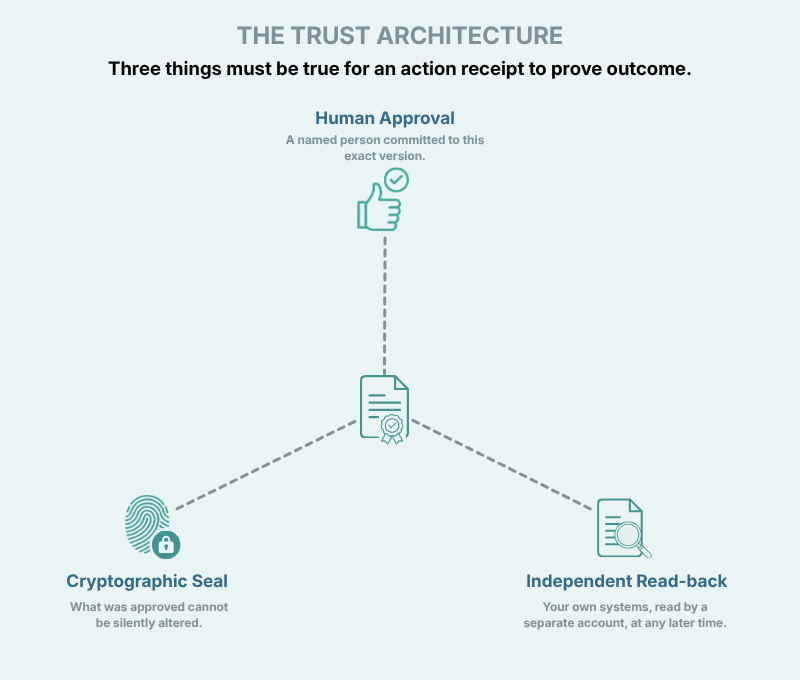
What each rung cannot do
Every mechanism has a scope. The three rungs we just described have theirs — and naming them here, in the same section that describes the rungs themselves, is the honest form of the architecture. A vendor whose limits section is generic hasn't examined their own system; a vendor whose limits map onto their own structure has.
Rung 1 — Human Approval — cannot make a bad decision good. A person seeing accurate facts can still approve a decision that shouldn't be made. A price that comes genuinely from your customer's message can still be the wrong price for the deal. Grounding — knowing the values are real — is not the same as correctness. The architecture ensures the person approving sees the facts as they are; what they do with those facts is judgment we cannot replace and should not try to.
Rung 2 — Cryptographic Seal — cannot prove the sealed content was true, and depends on how the signing key is held. A hash preserves the content it wraps against later alteration — it does not verify the content was correct when sealed. That is why the other two rungs exist. There is also a custody dimension: if the signing key that produces our seals were ever compromised, an attacker could forge signatures on fabricated receipts. Our answer to that has four parts, and every part is committed roadmap, not a shipped feature — we'd rather say that plainly than let a "today" slip in before it's true:
- A public verifier at a well-known address. Anyone will be able to drop a receipt file in and confirm two things — it hasn't been altered since sealing, and it was signed by a specific Pruvato key — entirely in their own browser, nothing uploaded to us.
- A published, append-only key manifest. The public half of every signing key we've ever used, with the date each became active and the date each was retired, at a fixed URL that only ever grows. The private half never leaves the signing environment and is destroyed on retirement.
- Transparency-log anchoring. Publishing each receipt's hash to a public append-only log at seal time — a stronger guarantee than a signature alone, because it proves we didn't sign a receipt after the fact.
- Verification against your own books. A mode of the verifier that reads the described record from your accounting system and confirms it still matches — real engineering, built once a design partner has asked for it.
All four ship on the same trigger: the first open-format receipt shipping to a design partner — this page will say "today" the day that's true, not before. And even once all four exist, the honest statement will still be that key custody is a trust we ask you to place in us, not something the cryptography alone eliminates. The public key history and the transparency log are what will make that trust checkable rather than blind.
Rung 3 — Independent Read-back — detects; it does not prevent. The read-back catches when your books no longer match what you approved — a manual edit in your accounting system, a change made by another tool sharing the same credentials, a customer-facing action taken by someone with their own access. What the read-back cannot do is stop those things from happening. No vendor can, or should, be able to prevent you from editing your own records. And no execution architecture reaches actions taken through tools other than this one, even when they use the same credentials — that governance has to happen where those tools live, not here.
And one honest limit above the three
Even together, the three rungs describe what happened — not what should have happened. A receipt confirmed against your books proves the world matches the approved version. It does not prove the approved version was the version your business needed. That last question is the one the Health Check exists to help you answer, before you commit to a workflow that will run this many times.